Energy Efficiency in the Production Process of the Modern Food Industry
DOI:
https://doi.org/10.62012/agrocomplex.vi.31Keywords:
Energy Efficiency, Food Industry, Production TechnologyAbstract
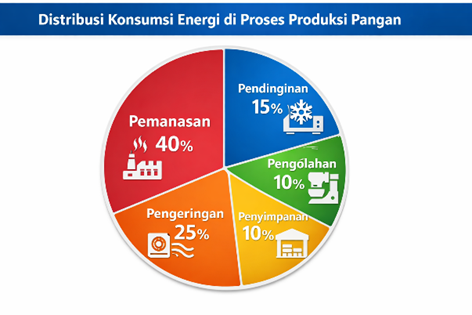
Energy efficiency in the production process of the modern food industry is an important aspect in supporting industrial sustainability and increasing product competitiveness. The food industry has high energy needs, especially in the process of heating, cooling, drying, and storage. Therefore, the application of energy-saving technologies such as production system automation, renewable energy utilization, and production system integration is a strategic solution to reduce energy consumption and operational costs. In addition, the development of digital technology such as the Internet of Things (IoT) allows for real time monitoring of energy use so that it can identify potential energy waste in the production process. The application of modern technology such as non-thermal processes and heat recovery systems has been proven to be able to increase energy efficiency without reducing the quality of food products. Energy efficiency efforts not only provide economic benefits for the industry, but also contribute to reducing greenhouse gas emissions and supporting the development of environmentally friendly industries. Collaboration between governments, researchers, and industry players is needed to encourage more efficient and sustainable technological innovation in facing future energy demand challenges.
Downloads
References
S. Ishchenko and M. Slinchak, “Energy efficient technologies in food production: examples and implementation,” Sci. Technol. Innov., 2025, doi: 10.35668/2520-6524-2024-4-13.
F. Faraldo and P. Byrne, “A Review of Energy-Efficient Technologies and Decarbonating Solutions for Process Heat in the Food Industry,” Energies, 2024, doi: 10.3390/en17123051.
K. Chojnacka et al., “Improvements in drying technologies - Efficient solutions for cleaner production with higher energy efficiency and reduced emission,” J. Clean. Prod., vol. 320, p. 128706, 2021, doi: 10.1016/j.jclepro.2021.128706.
A. Hassoun et al., “Food processing 4.0: Current and future developments spurred by the fourth industrial revolution,” Food Control, 2022, doi: 10.1016/j.foodcont.2022.109507.
F. M. Kanchiralla, N. Jalo, P. Thollander, M. Andersson, and S. Johnsson, “Energy use categorization with performance indicators for the food industry and a conceptual energy planning framework,” Appl. Energy, 2021, doi: 10.1016/j.apenergy.2021.117788.
B. Yudhistira, P. Adi, R. Mulyani, C.-K. Chang, M. Gavahian, and C.-W. Hsieh, “Achieving sustainability in heat drying processing: Leveraging artificial intelligence to maintain food quality and minimize carbon footprint.,” Compr. Rev. food Sci. food Saf., vol. 23 5, 2024, doi: 10.1111/1541-4337.13413.
J.-M. Clairand, M. Briceño-León, G. Escrivá-Escrivá, and A. Pantaleo, “Review of Energy Efficiency Technologies in the Food Industry: Trends, Barriers, and Opportunities,” IEEE Access, vol. 8, pp. 48015–48029, 2020, doi: 10.1109/access.2020.2979077.