Rice Productivity Trends and Food Security Implications in Indonesia
Evidence from Agricultural Statistics 2025
DOI:
https://doi.org/10.62012/pdpv7n52Keywords:
Rice Productivity, Food Security, Harvested Area, Agricultural Statistics, IndonesiaAbstract
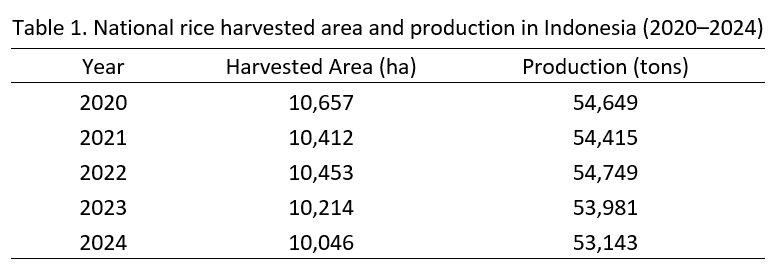
Rice remains the cornerstone of Indonesia’s food security strategy and plays a vital role in supporting national economic development and agricultural sustainability. Understanding recent productivity trends is essential for evaluating the country’s capacity to achieve long-term food self-sufficiency objectives. This study aims to examine changes in rice harvested area, production, and productivity in Indonesia using official national agricultural statistics. The research employed a quantitative descriptive approach based on secondary data obtained from Agricultural Statistics 2025 published by the Ministry of Agriculture. Trend analysis was conducted using national rice production indicators from 2020 to 2024. The results indicate that harvested area declined from 10.657 million hectares in 2020 to 10.046 million hectares in 2024, while rice production decreased from 54.649 million tons to 53.143 million tons during the same period. Despite the contraction in harvested area, national rice productivity remained relatively stable, reaching 52.90 quintals per hectare in 2024, suggesting improvements in cultivation efficiency and technological adoption. These findings imply that productivity enhancement has partially offset reductions in cultivated land, thereby supporting Indonesia’s food security objectives. The study highlights the importance of innovation-driven agricultural policies, sustainable land management, and productivity-oriented interventions to strengthen national food resilience amid increasing pressure on agricultural resources.
Downloads
References
[1] Ministry of Agriculture of the Republic of Indonesia, Statistik Pertanian 2025 / Agricultural Statistics 2025. Jakarta, Indonesia: Ministry of Agriculture, 2025.
[2] BPS-Statistics Indonesia, Paddy Harvested Area and Production in Indonesia 2024. Jakarta, Indonesia: BPS-Statistics Indonesia, 2025.
[3] BPS-Statistics Indonesia, “Harvested Area, Productivity, and Production of Paddy by Province, 2024,” Jakarta, Indonesia, 2025.
[4] Food and Agriculture Organization of the United Nations, The State of Food Security and Nutrition in the World 2024. Rome, Italy: FAO, 2024.
[5] Food and Agriculture Organization of the United Nations, World Food and Agriculture: Statistical Yearbook 2024. Rome, Italy: FAO, 2024.
[6] World Bank, Indonesia Economic Prospects: Strengthening Resilience. Washington, DC, USA: World Bank, 2024.
[7] International Rice Research Institute, “IRRI in Indonesia,” Los Baños, Philippines: International Rice Research Institute, 2024.
[8] R. L. Naylor, D. S. Battisti, D. J. Vimont, W. P. Falcon, and M. B. Burke, “Assessing risks of climate variability and climate change for Indonesian rice agriculture,” Proc. Natl. Acad. Sci., vol. 104, no. 19, pp. 7752–7757, 2007, doi: 10.1073/pnas.0701825104.
[9] Y. Apriyana, E. Estiningtyas, A. Pramudia, F. Ramadhani, and H. Sarvina, “The Transformation of Rice Crop Technology in Indonesia: Innovation and Sustainable Food Security,” Agronomy, vol. 13, no. 1, 2023, doi: 10.3390/agronomy13010001.
[10] N. Ramadhan, “The Influence of Climate Change on Rice Production and Cultivation Patterns in Indonesia,” Jurnal Agronomi Tanaman Tropika (JUATIKA), vol. 6, no. 1, pp. 167–180, 2024, doi: 10.36378/juatika.v6i1.3374.
[11] M. Yusuf, S. Sundari, I. D. Purwanto, and R. R. Kurnia, “Rice Production, Policies, and Their Implications on Food Security: Indonesia–Thailand Perspective,” Jurnal Multidisiplin Madani, vol. 4, no. 1, pp. 174–179, 2024, doi: 10.55927/mudima.v4i1.7927.
[12] C. P. Hannida, “Analysis of the Effect of Rice Production, Poverty, and Prevalence of Undernourishment on Food Security in Indonesia,” SEPA: Jurnal Sosial Ekonomi Pertanian dan Agribisnis, vol. 22, no. 1, 2025, doi: 10.20961/sepa.v22i1.90327.
[13] F. Fitriani, “Climate Changing Impact on Rice Production,” Journal of Food System and Agribusiness, vol. 1, no. 1, pp. 1–11, 2017.
[14] M. F. Ikhwali, M. A. R. Fadhil, and R. Kurniawan, “A Review of Climate Change Studies on Paddy Agriculture in Indonesia,” IOP Conf. Ser.: Earth Environ. Sci., vol. 922, 2021.
[15] A. Y. Ismail, “Sustainable Rice Farming in Indonesia,” African Journal of Food, Agriculture, Nutrition and Development, vol. 24, no. 1, pp. 1–15, 2024.
[16] N. V. Nguyen, Sustainable Intensification of Rice Production for Food Security. Rome, Italy: Food and Agriculture Organization of the United Nations, 1990.
[17] G. Denning, “Sustainable Intensification of Agriculture: The Foundation for Food Security,” Nature Food, vol. 6, pp. 1–8, 2025.
[18] N. K. Fukagawa and L. H. Ziska, “Rice: Importance for Global Nutrition,” Journal of Nutritional Science and Vitaminology, vol. 65, Suppl., pp. S2–S3, 2019, doi: 10.3177/jnsv.65.S2.
[19] A. D. Putri, “Forecasting Indonesia’s Rice Production in 2024,” Seminar Nasional Official Statistics, pp. 1–10, 2024.
[20] A. Rajab, “Critical Review of Food Security Budget and Imports of Rice in Indonesia,” Jurnal Budget, vol. 8, no. 1, pp. 1–20, 2023.