User Satisfaction and Utilization Patterns of Indonesia's National Food Data Portal
Evidence from the First Quarter 2026 Survey
DOI:
https://doi.org/10.62012/sxt1w802Keywords:
Food Data Portal, User Satisfaction, Agricultural Information System, Open Government Data, Food PolicyAbstract
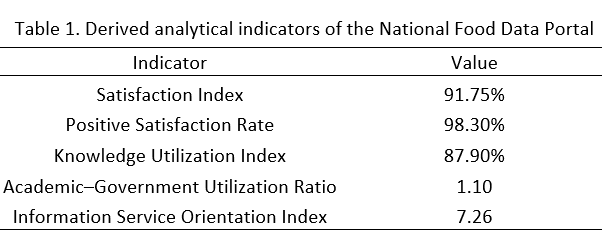
The National Food Data Portal is an important digital platform supporting agricultural information, research, and evidence-based policymaking in Indonesia. This study analyzed user satisfaction and utilization patterns using the First Quarter 2026 User Satisfaction Survey published by the National Food Agency. A descriptive quantitative approach based on secondary data analysis was employed. In addition to descriptive statistics, several analytical indicators were calculated, including the Satisfaction Index (SI), Positive Satisfaction Rate (PSR), Knowledge Utilization Index (KUI), Academic–Government Utilization Ratio (AGUR), and Information Service Orientation Index (ISOI). The results showed that the portal achieved a Satisfaction Index of 91.75% and a Positive Satisfaction Rate of 98.3%. Research (46.8%) and policy preparation (37.1%) represented the dominant utilization purposes, resulting in a Knowledge Utilization Index of 87.9%. Academic users accounted for 46.0% of total users, followed by government institutions (41.9%). The Information Service Orientation Index reached 7.26, indicating that the portal is primarily utilized for research and evidence-based policymaking. These findings demonstrate that the National Food Data Portal has become an important digital infrastructure supporting agricultural research and food governance in Indonesia.
Downloads
References
[1] National Food Agency, User Satisfaction Survey of the National Food Data Portal: First Quarter 2026. Jakarta, Indonesia: National Food Agency, 2026.
[2] National Food Agency, National Food Data Portal. Jakarta, Indonesia: National Food Agency, 2026.
[3] National Food Agency, Food Security and Vulnerability Atlas 2024. Jakarta, Indonesia: National Food Agency, 2024.
[4] BPS-Statistics Indonesia, Statistics Indonesia 2025. Jakarta, Indonesia: BPS-Statistics Indonesia, 2025.
[5] BPS-Statistics Indonesia, Agricultural Indicators 2025. Jakarta, Indonesia: BPS-Statistics Indonesia, 2025.
[6] Ministry of Agriculture of the Republic of Indonesia, Agricultural Statistics 2025. Jakarta, Indonesia: Ministry of Agriculture, 2025.
[7] Ministry of Agriculture of the Republic of Indonesia, Strategic Plan of the Ministry of Agriculture 2025–2029. Jakarta, Indonesia: Ministry of Agriculture, 2025.
[8] Ministry of National Development Planning/BAPPENAS, National Medium-Term Development Plan 2025–2029. Jakarta, Indonesia: BAPPENAS, 2025.
[9] Food and Agriculture Organization of the United Nations, The State of Food Security and Nutrition in the World 2024. Rome, Italy: FAO, 2024.
[10] Food and Agriculture Organization of the United Nations, World Food and Agriculture: Statistical Yearbook 2024. Rome, Italy: FAO, 2024.
[11] Food and Agriculture Organization of the United Nations, E-Agriculture Strategy Guide. Rome, Italy: FAO, 2017.
[12] World Bank, World Development Report 2021: Data for Better Lives. Washington, DC, USA: World Bank, 2021.
[13] World Bank, GovTech Maturity Index 2022 Update. Washington, DC, USA: World Bank, 2022.
[14] OECD, Digital Government Review of Indonesia: Towards a Data-Driven Public Sector. Paris, France: OECD Publishing, 2020.
[15] OECD, Open Government Data Report: Enhancing Policy Maturity for Sustainable Impact. Paris, France: OECD Publishing, 2018.
[16] United Nations, United Nations E-Government Survey 2024. New York, NY, USA: United Nations, 2024.
[17] European Commission, Open Data Maturity Report 2024. Luxembourg: Publications Office of the European Union, 2024.
[18] W. H. DeLone and E. R. McLean, “The DeLone and McLean model of information systems success: A ten-year update,” Journal of Management Information Systems, vol. 19, no. 4, pp. 9–30, 2003.
[19] A. Parasuraman, V. A. Zeithaml, and L. L. Berry, “SERVQUAL: A multiple-item scale for measuring consumer perceptions of service quality,” Journal of Retailing, vol. 64, no. 1, pp. 12–40, 1988.
[20] J. C. Bertot, P. T. Jaeger, and J. M. Grimes, “Using ICTs to create a culture of transparency: E-government and social media as openness and anti-corruption tools,” Government Information Quarterly, vol. 27, no. 3, pp. 264–271, 2010.